



That’s the thing about records and FKT – Fastest Known Times : they’re meant to be broken, even on the most famous ski race in the Alps. The recent women’s record set by American born and French citizen Hillary Gerardi and French Valentine Fabre on the Chamonix-Zermatt route lasted only three days, until two young French women, Laurie Renoton and French Marie Pollet-Villard, lowered the mark to 8:34 p.m.—two hours faster than their predecessors, who themselves had broken their own record set in 2021 after two Swiss women had taken the record in 2025. Losing track? Oh well.
Let’s summarize: the explosion in ski mountaineering is leading to a surge in women’s mountain records, following in the footsteps of male athletes. A few days earlier, French Mathéo Jacquemoud and Italian William Boffelli kicked things off on Cham’ Zermatt with a breathtaking time of 13:27.
But actually, why Cham’ Zermatt? Why not Andermatt to Zermatt (A to Z !), which, you have to admit, would sound pretty cool? Because it was the English aristocrats, in the 19th century, who established what they called the Haute Route between their two Alpine vacation spots and “playgrounds” (the expression is Sir Leslie Stephen’s).
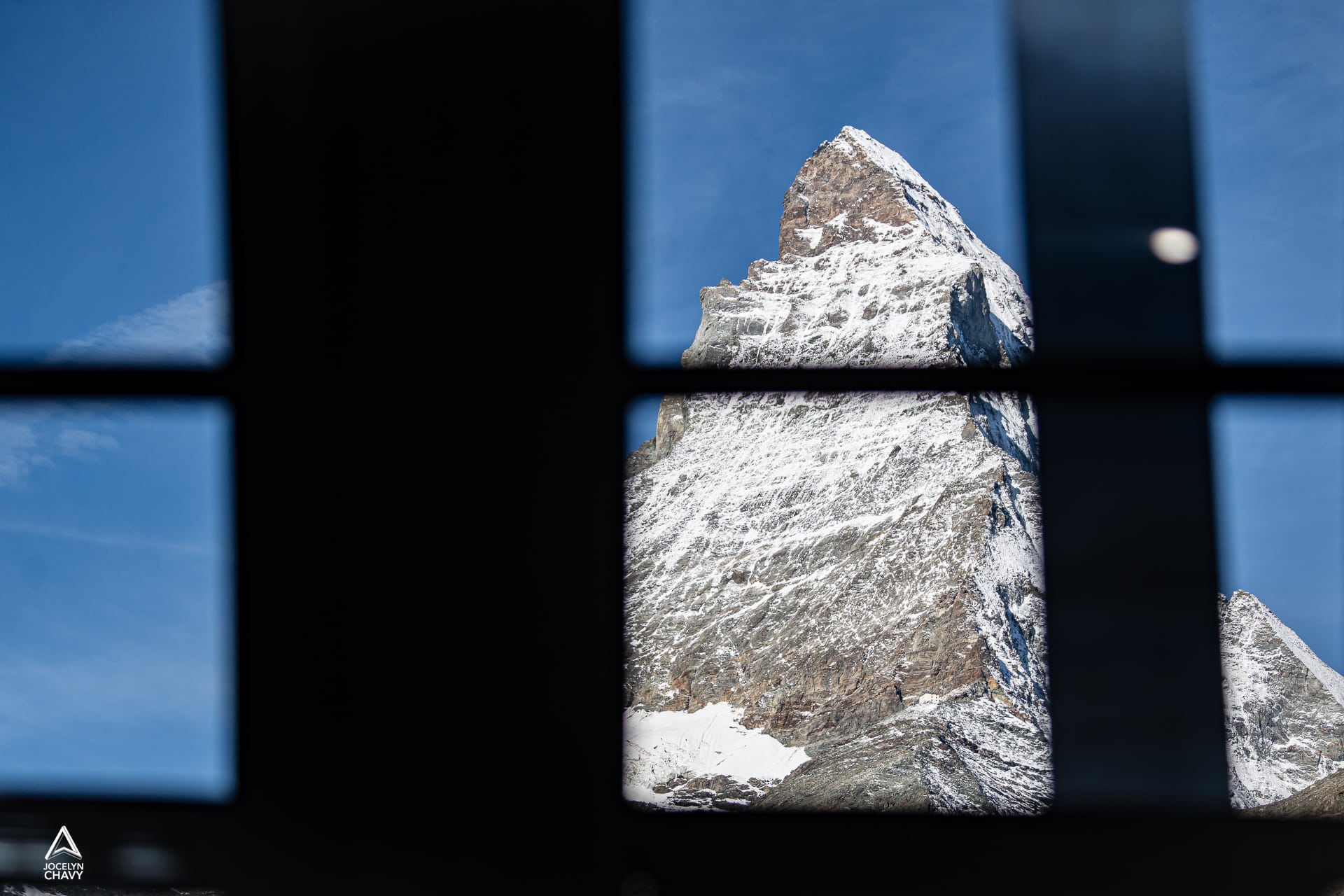
Matterhorn, from Zermatt neighborhood ©Jocelyn Chavy
But let’s give credit where credit is due to Michel Payot. The good doctor from Chamonix was the first to bring skis back from Norway to Chamonix in 1902. On January 17, 1903, he set out on the first winter crossing from Chamonix to Zermatt with the valley’s guides: Joseph Ravanel—known as “Le Rouge”—Alfred Simond, and Joseph Couttet.
It was an epic journey, with two-meter-long skis, sealskins, an 1.8-meter-long ash pole per person, and enormous backpacks. Their progress was slow, sometimes improvised, depending on the condition of the treacherous snow bridges: the menu included frozen roast beef and wine, skis turned into sleds, a forced retreat and a train ride between Martigny and Sion, and arrival in Zermatt after hours of wandering on the glacier five days later, on January 21, 1903. The challenge was not speed, but time—the time it took to explore on skis.
this transformation of the mountain into data, of a glacier into a Strava segment, of a mountain hut into a refueling station
A century later, speed has changed everything. It has altered our perception of distances, of things, and of the mountains themselves. A reader and subscriber to Alpine Mag wrote to us to denounce what he calls “Tour de France-style mountaineering,” because whether it’s the women’s or men’s record from Chamonix to Zermatt, these records rely on a support or supply team that is inevitably motorized—including for Mathéo Jacquemoud’s bike-ski crossing of the Alps or Jocelyn Verdenal’s Mediterranean-Monte Rosa record.
Our reader suggests that the situation is heading in the wrong direction, when the record-holder(s) insist on a non-motorized record, yet achieve it with motorized assistance… or not.
Let’s take one of Kilian Jornet’s records—or Fastest Known Time, an expression coined in the United States, the land of speed and excess. In this case, the Matterhorn record in 2013, where the incredible performance (1h56 on the ascent, 2h52 round trip from Cervinia) was supported by more than half a dozen guides at key points, and criticized for it—which does not diminish the risk. A French philosopher of speed, Paul Virilio says much the same thing when he writes that every acceleration has its downside, every rocket carries the possibility of a crash.
Are ski mountaineers—now reduced to mere projectiles—aware of this transformation of the mountain into data, of a glacier into a Strava segment, of a mountain hut into a refueling station? Virilio gave a name to this logic: dromology. Going fast—the power of speed—is a way of transforming what we traverse. In a sense, of reducing it.
It’s not just the technology that has changed. It’s also a certain idea of what people are looking for up there
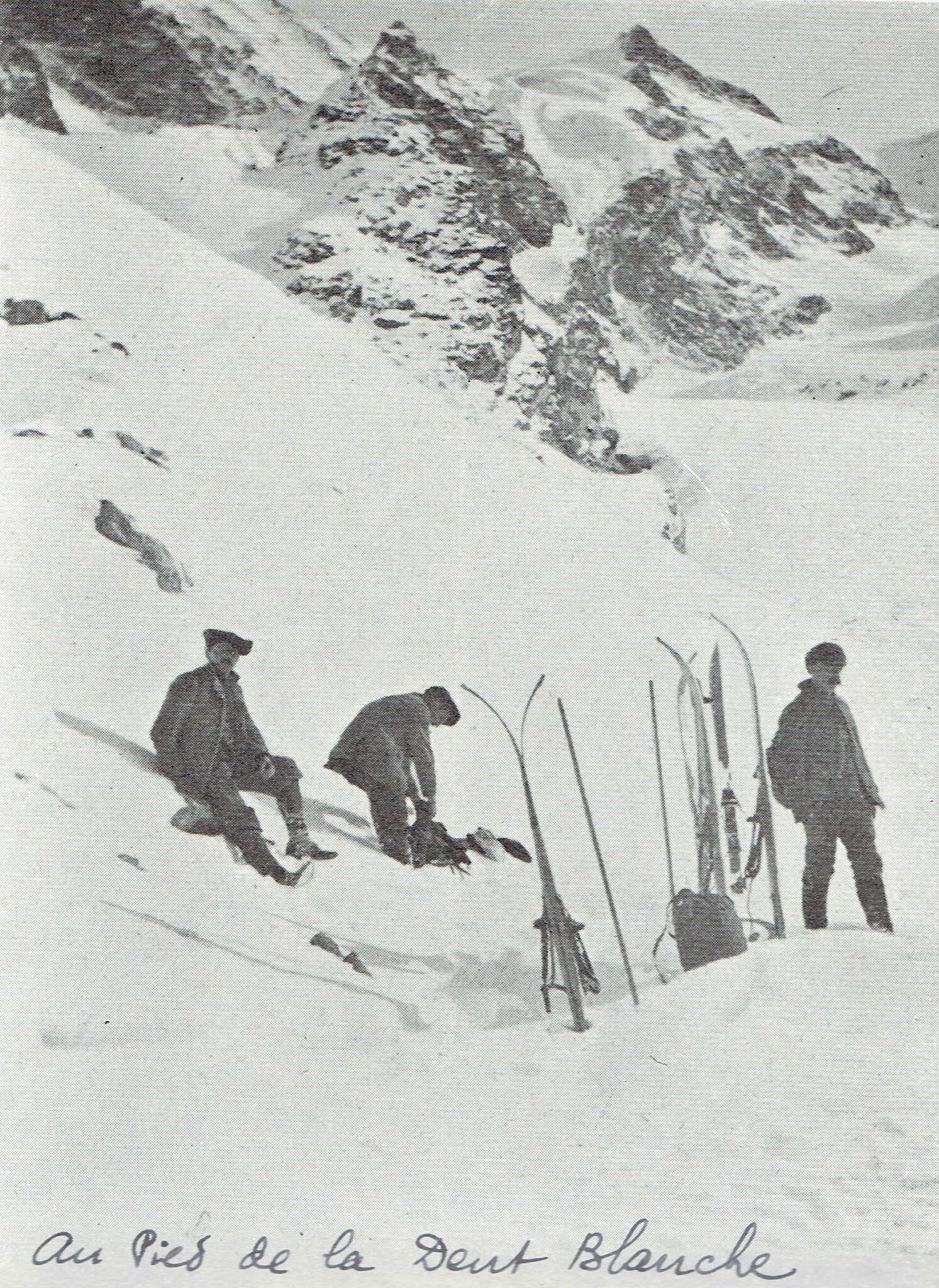
Michel Payot and friends, First Winter Chamonix Zermatt, January 1903.
Moving fast in the mountains is nothing new. But in recent years, the phenomenon has seen a dramatic expansion: whether it’s Kilian Jornet’s 82 four-thousanders in 19 days, or the Nose on El Capitan in under 2 hours (Caldwell and Honnold), or Benjamin Védrines’ complete ascent of Peuterey in 6 hours and 51 minutes (his greatest alpine feat?), these breathtaking records seem unbeatable. Have they, in the process, diminished the 4,000-meter peaks, Mont Blanc, or the benchmark kilometer of American granite? Not for the average person.
Yet this frenzy for records says something about our era. Celebrating a record is legitimate. Admiring the performance, too. But without erasing what this Chamonix-Zermatt crossing carries in terms of memory, harshness, depth, and the passage of time.
How? By giving a voice, as we try to do at Alpine Mag, to those who lived through this experience, to draw something other than the brutality of the stopwatch from it.
Between the 1903 caravan advancing on a tightrope amid crevasses and the records where every second counts, it’s not just the technique that has changed. It’s also a certain idea of what we’re seeking up there.