

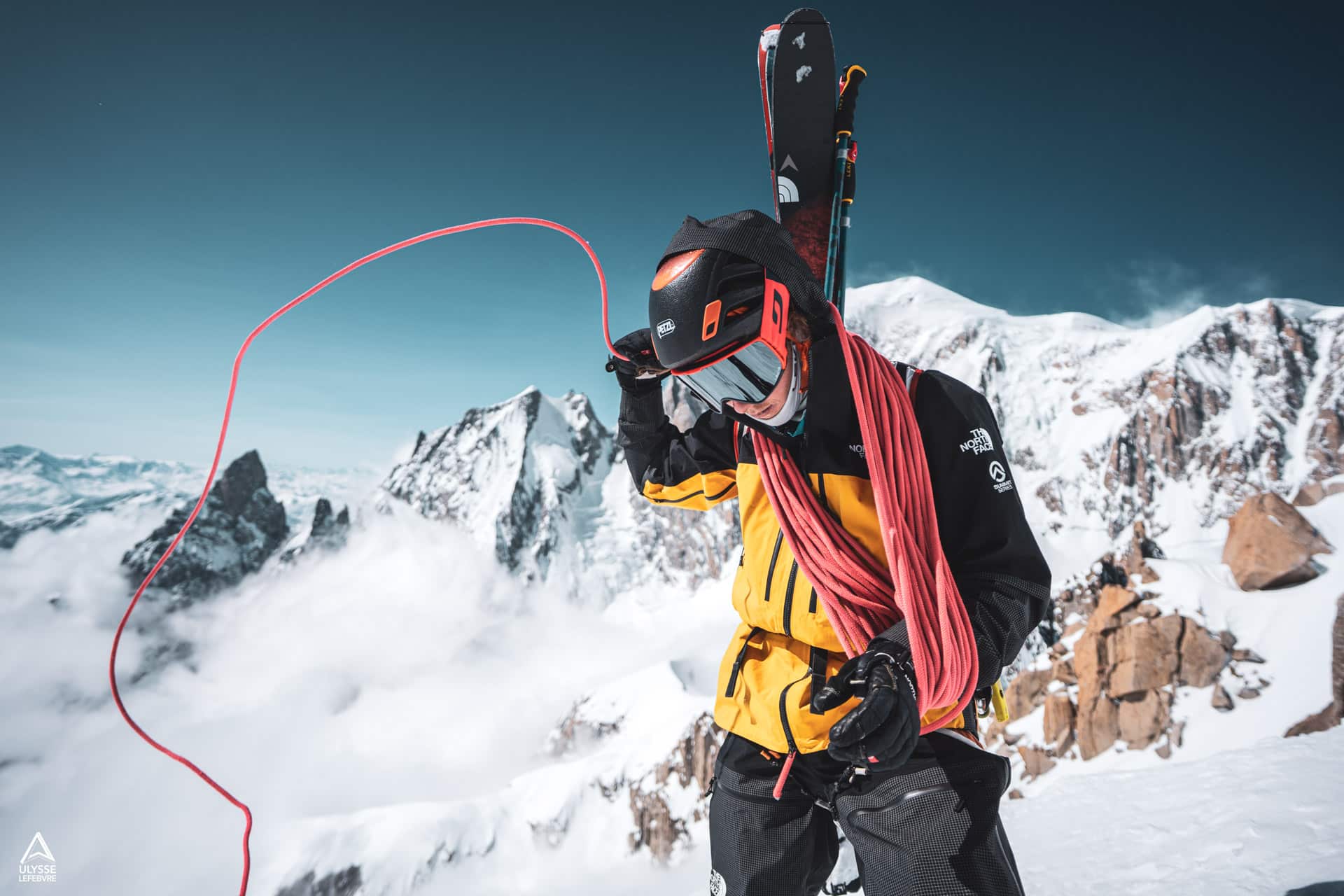
At 24, Tom Lafaille carries a huge name, but moves forward lightly. Son of mountaineer Jean-Christophe Lafaille, who died on Makalu in 2006, he is now forging his own path in the Alps and Himalayas, both skiing and mountaineering, with surprising maturity and a keen sense of mountain ethics. On the occasion of the launch of the new Gore-Tex Pro membrane in Courmayeur, Italy, we met Tom in his home territory of Mont Blanc, skis on his feet at the Tour Ronde.
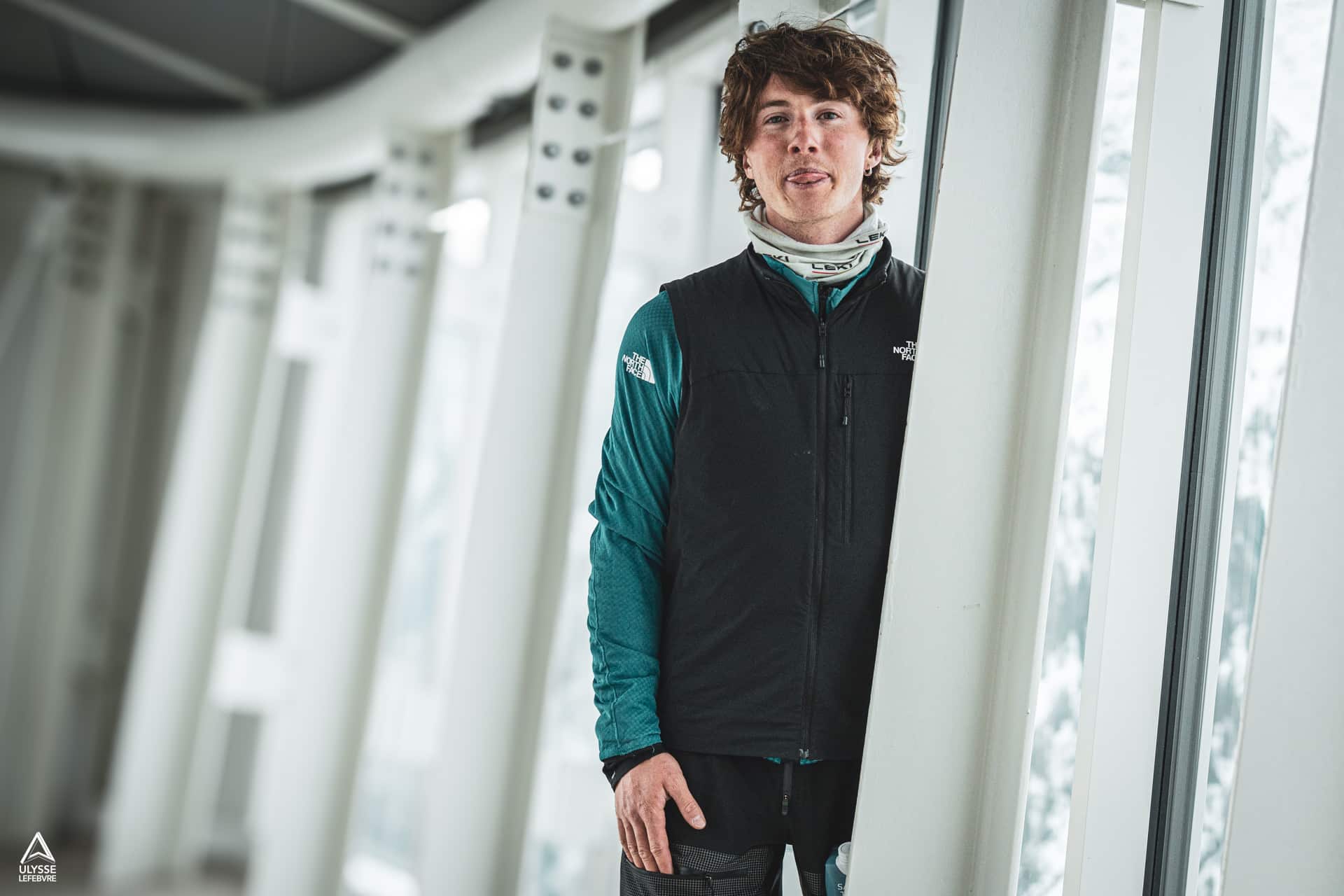
As we climb into the gleaming Skyway cable car for our last ski trip of spring 2025, a little guy shows up with his skis in hand and a bag on his back. His golden curls peek out from under his neck warmer pulled up over his ears, as does his big smile, even this early in the morning. Tom Lafaille greets a journalist-skier he doesn’t know with the cheerfulness of someone who knows he’s going skiing. And that’s enough to make him happy.
For my part, I say hello to him with that unsettling feeling of déjà vu. Physically, Tom looks a lot like Jean-Christophe. Short and stocky, he combines a baby face with chubby cheeks that betray his twenties with the finer, more angular features of the late « Jean-Chri ».
I mumble few words while thinking about this mountaineering idol who, without a doubt, still lives on in the eyes of his son standing before me.
A path forged at an early age
Born on 31 March 2001, Tom Lafaille became an aspiring guide at the age of 18 and took on his first client at just 20. « I was a brat in high school, » he smiles.
« I worked one summer as a landscaper and realised I had to find my path. » That path first led him to competitive alpine skiing, with a coach who was unlike any other: Vivian Bruchez.
I was a brat in high school
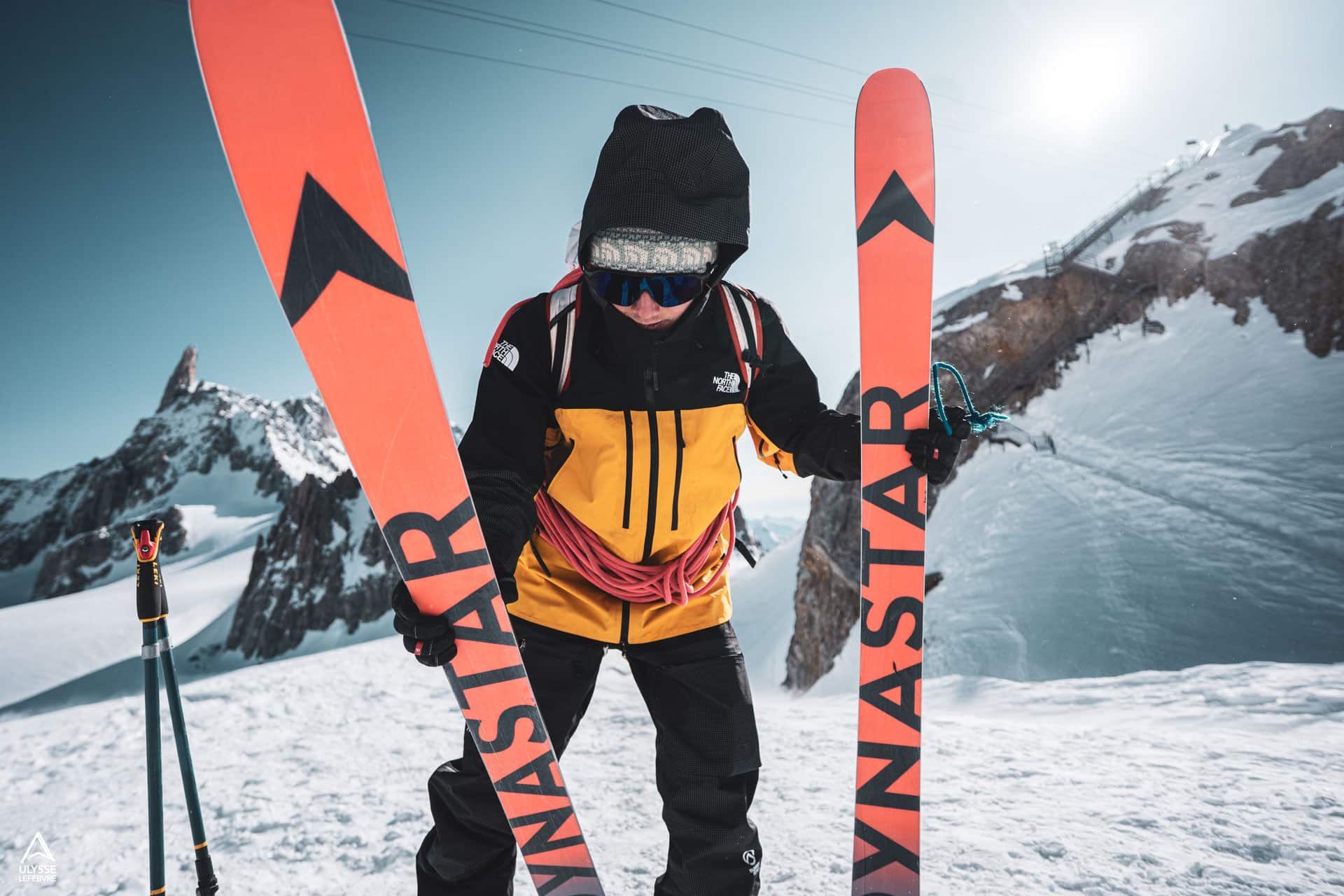
Tom prépare les skis, à la descente du Skyway. ©UL / Gore-Tex
« It was great to have him as a coach when he was just starting to make a name for himself » he says. It was Bruchez who lent him his touring skis for his first ski touring outing, « the ones he had used for one of his first great first ascents, the Migot spur at Chardonnet with Kilian Jornet » [in 2012, editor’s note].
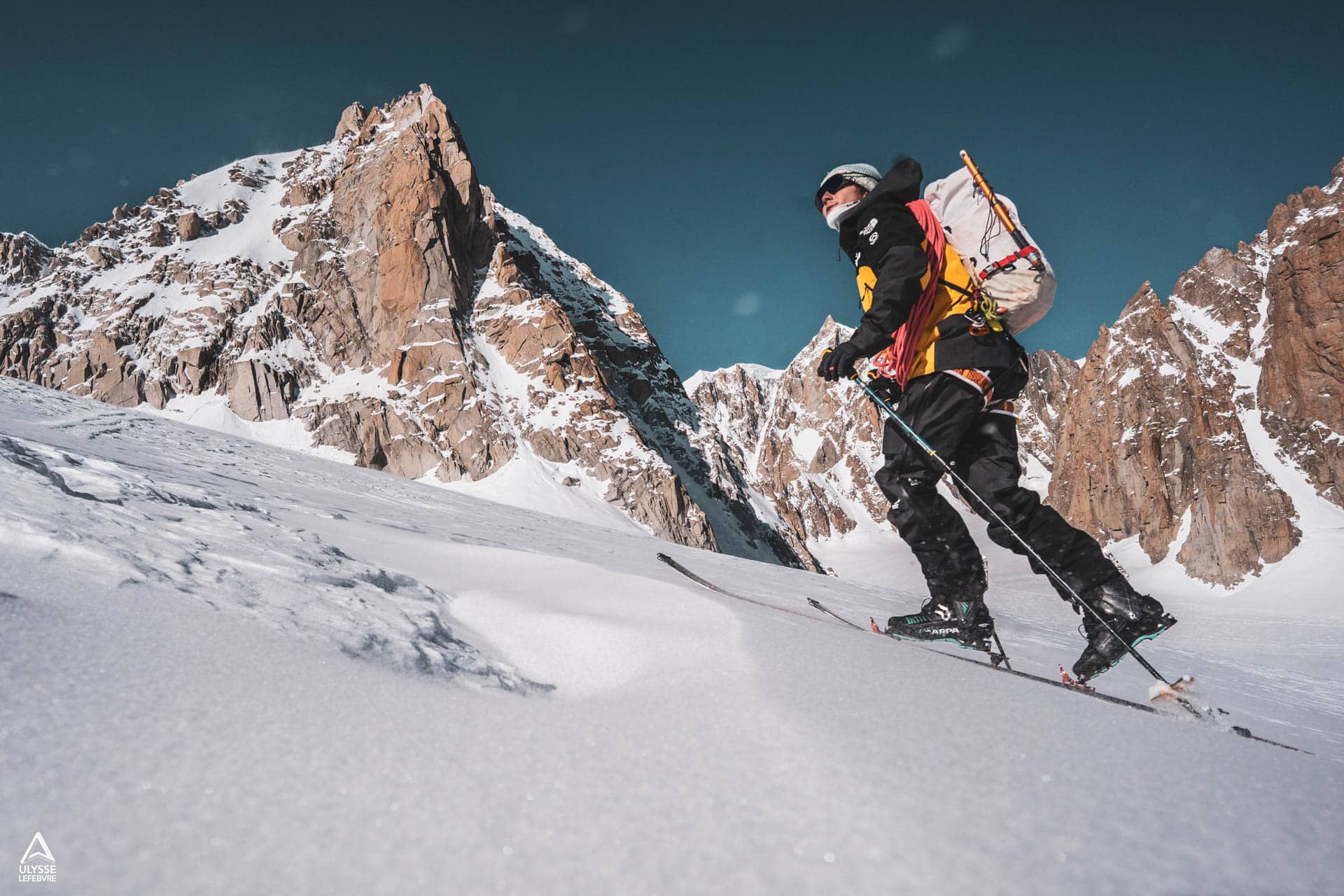
Approaching the Tour Ronde, in the Cirque Maudit (Mont Blanc). ©UL / Gore-Tex
But Tom eventually left the competition: « One day I decided to quit. I told Vivian, and I took up climbing ». Within a year, he was climbing 8a. Had he found his calling? Or was he following in the footsteps of his father, who opened Biographie in Ceüse in 1990, the first 9a+ in history, only to be matched 11 years later by Chris Sharma? Not necessarily. « And then it was the same scenario all over again. I had to start competing, etc. So I started mixing it all up and going to the mountains » he explains as he crosses the majestic Cirque Maudit.
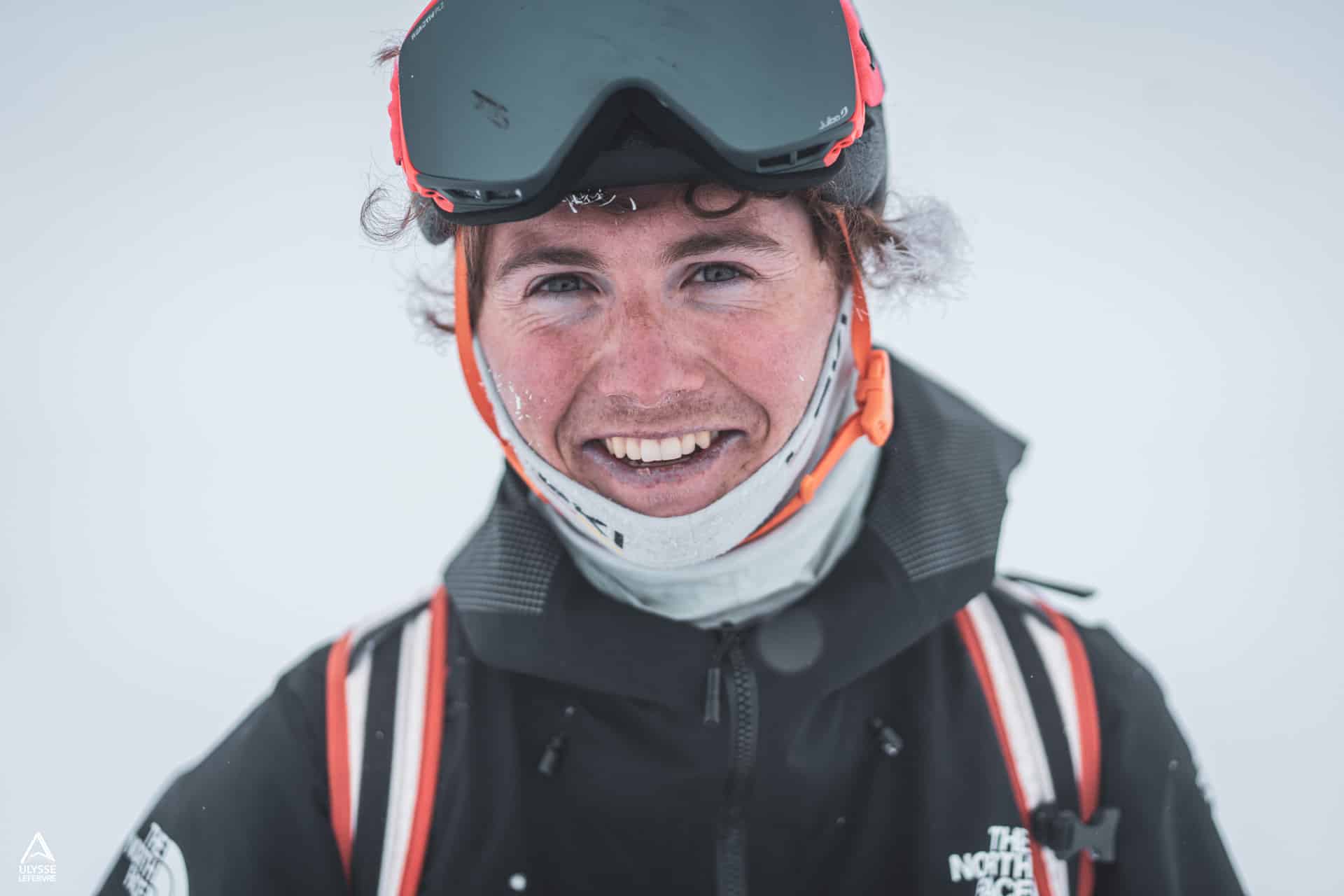
Smile is the key. ©UL / Gore-Tex
And the early days spent in the high mountains were not necessarily very orthodox. Outings mainly took place during school hours. « We would go to the mountains instead of going to secondary school. The PGHM (French High Mountain Rescue Team) was often aware of this because we weren’t very safety-conscious with our mates! » recalls the young guide, who is now busy roping up his client on the gentle slope of the normal route up the Tour Ronde.
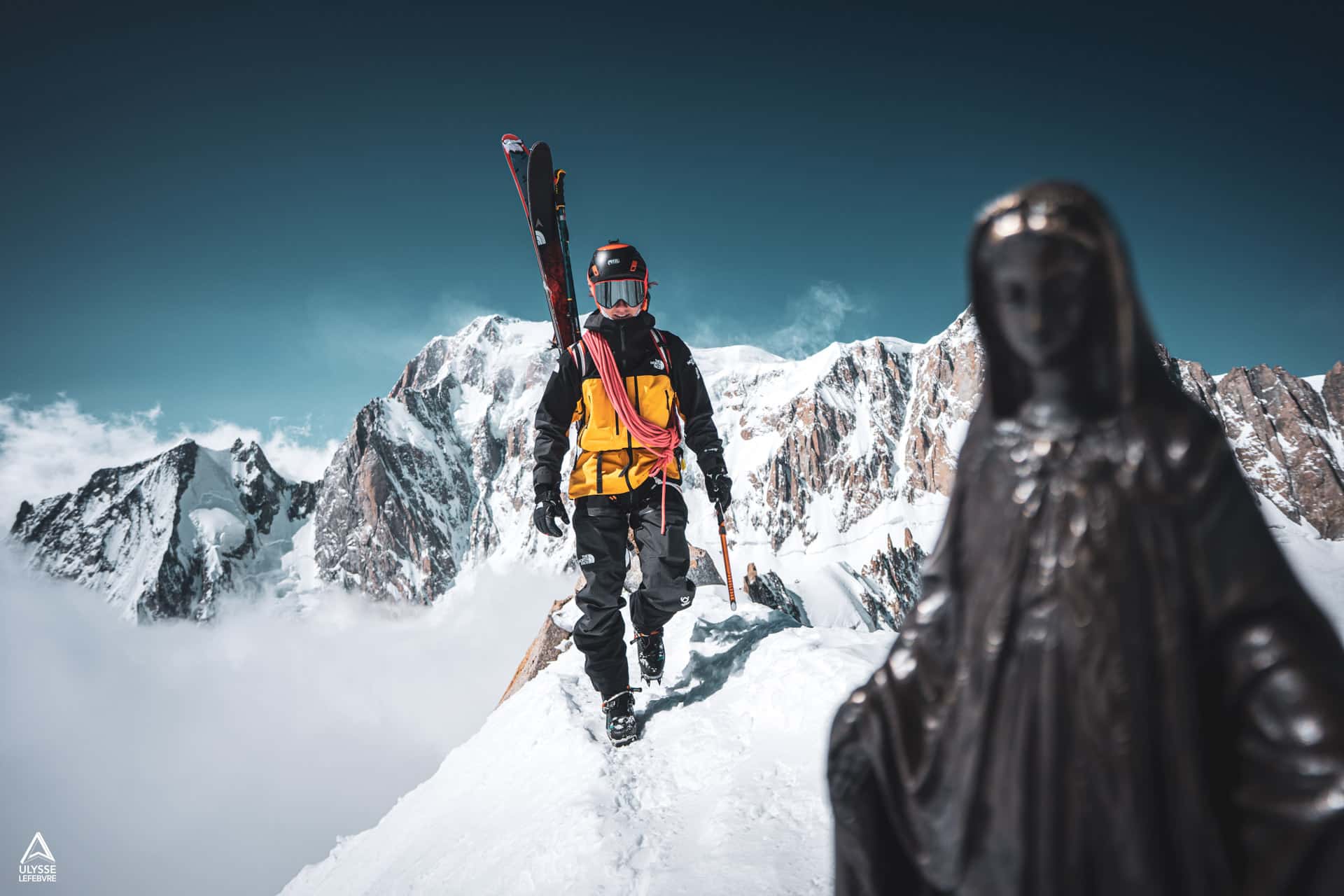
Upon reaching the top of la Tour Ronde, greeted by the Madonna. ©UL / Gore-Tex
The French High Mountain Rescue Team
was often aware of this because
we weren’t very safety-conscious with our mates!
From there, everything fell into place: his first races, his first expeditions, and soon, his guide certification list. He will receive his medal in the summer of 2024, just after sending his supplementary list at the last minute from the Nanga Parbat base camp via his InReach. Priority is given to the peaks of Pakistan. Skiing at 8,000 metres has become his trademark. For now, he is disappointed to see, from the summit, that the Gervasutti is not in good condition. No matter, he can push a little harder on the descent of the normal route.
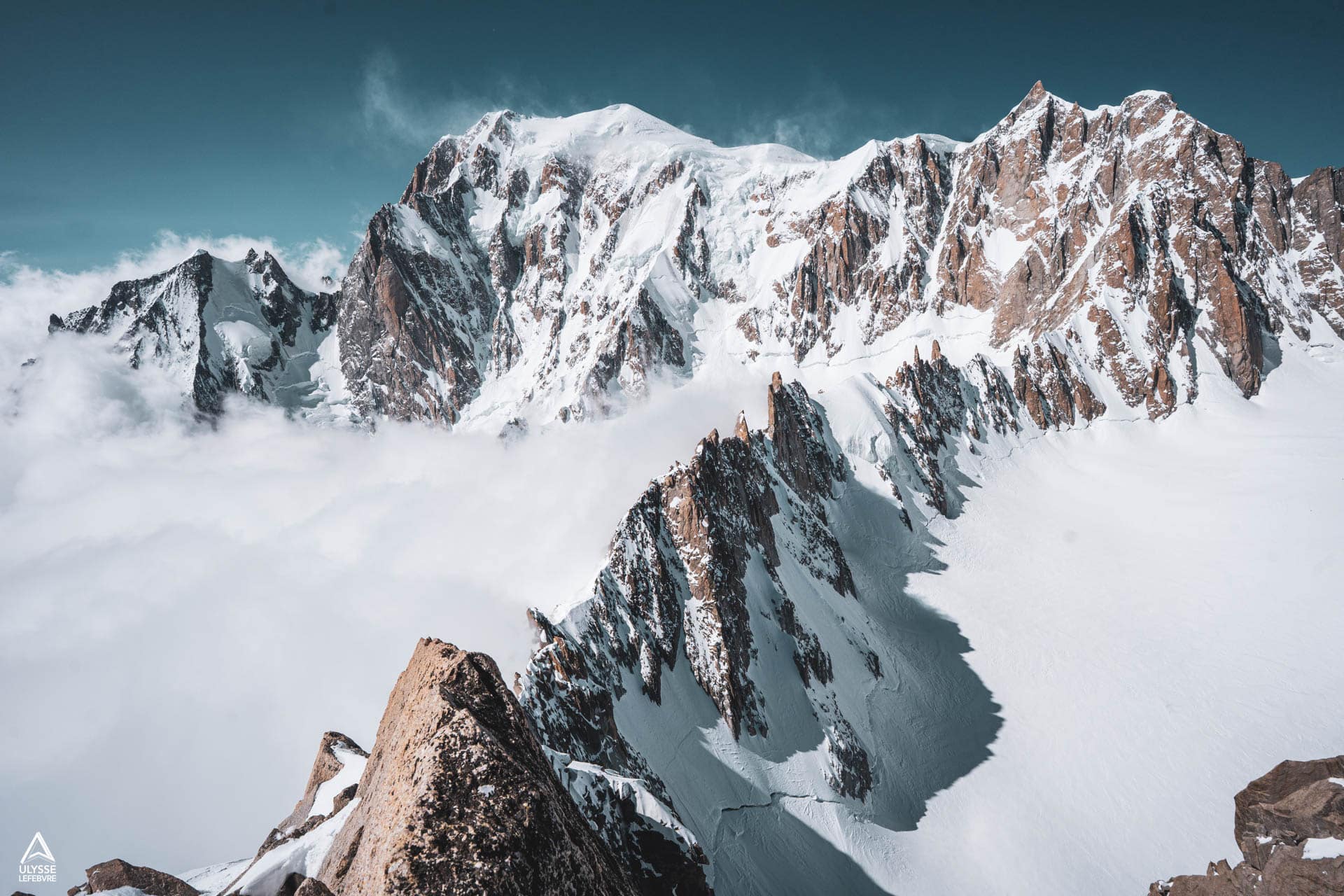
The Küffner ridge, Mont Maudit and Mont Blanc unfold beneath our skis. ©UL / Gore-Tex
A new horizon at 8,000 metres
Makalu, the mountain where his father disappeared, keeps coming back into view. Five years and three months after Jean-Christophe’s disappearance, Paris Match finances his family’s return to base camp, where a Buddhist monk is erecting a memorial made of concrete and stones.
« I was shielded from the controversy surrounding my father’s disappearance because we lived in Vallorcine. It’s a small village, another world » he says today. « But looking back, there are some people I shouldn’t go to the mountains with. I say hello to them, but that’s it » he says during a brief moment when his good-naturedness fades.
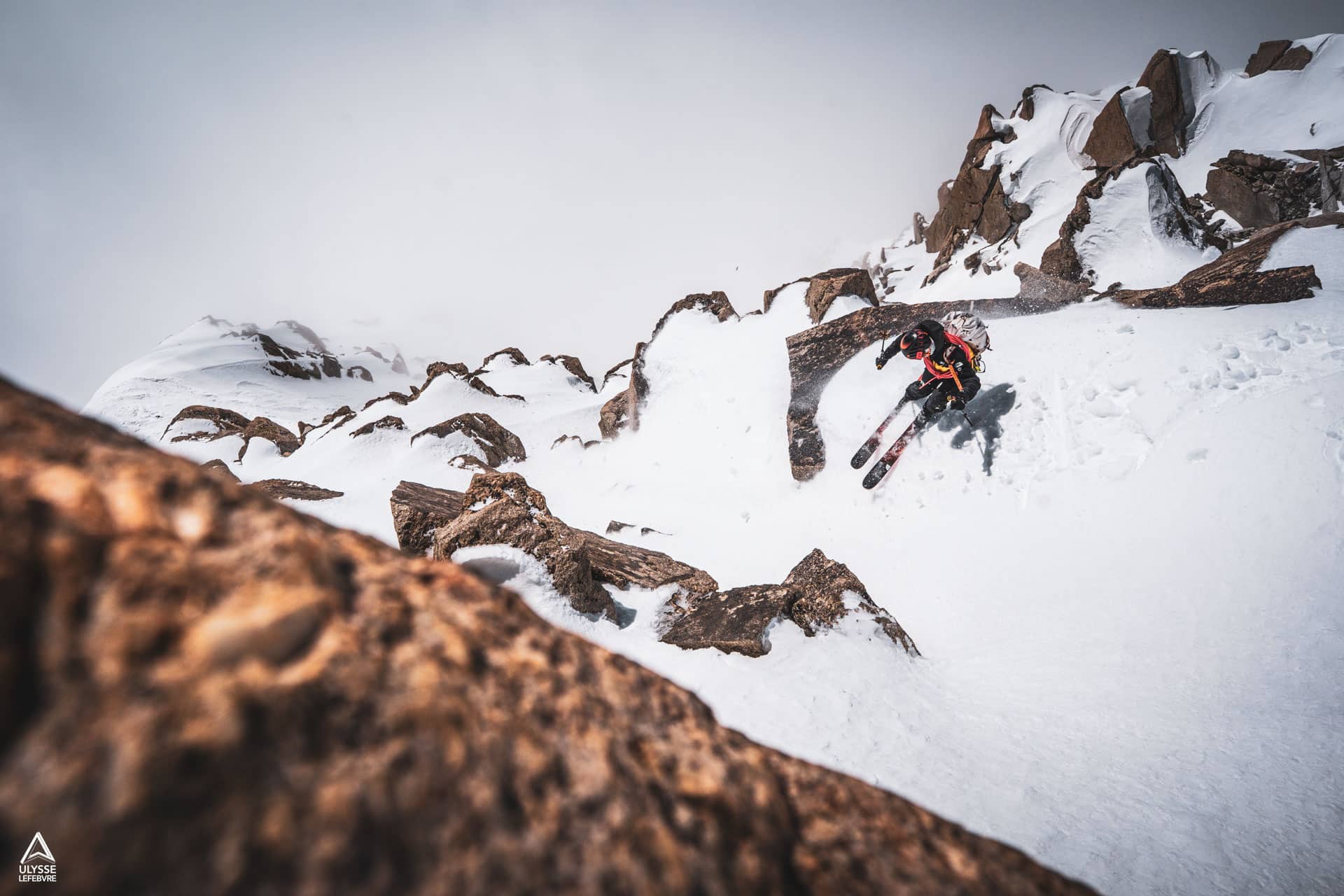
©UL / Gore-Tex
Tom was five years old when his father disappeared in 2006, but malicious gossip is persistent and continued for a long time to comment on Jean-Christophe’s gargantuan project, which aimed to climb the 14 peaks over 8,000 metres on the planet alone and in winter. The management of Jean-Christophe’s career by his wife, Kathy, Tom’s mother, also drew a lot of criticism. Jean-Christophe’s body still lies somewhere on the slopes of Makalu, his twelfth 8,000-metre peak.
Tom, however, never stopped dreaming of the Himalayas. « Tom always dreamed of Makalu, perhaps more and more » one of his close friends whispered to me the day before. This dream crystallised around Makalu, with the goal of climbing it and then skiing down. A big project for 2026, « if all goes well, » Tom cautions.
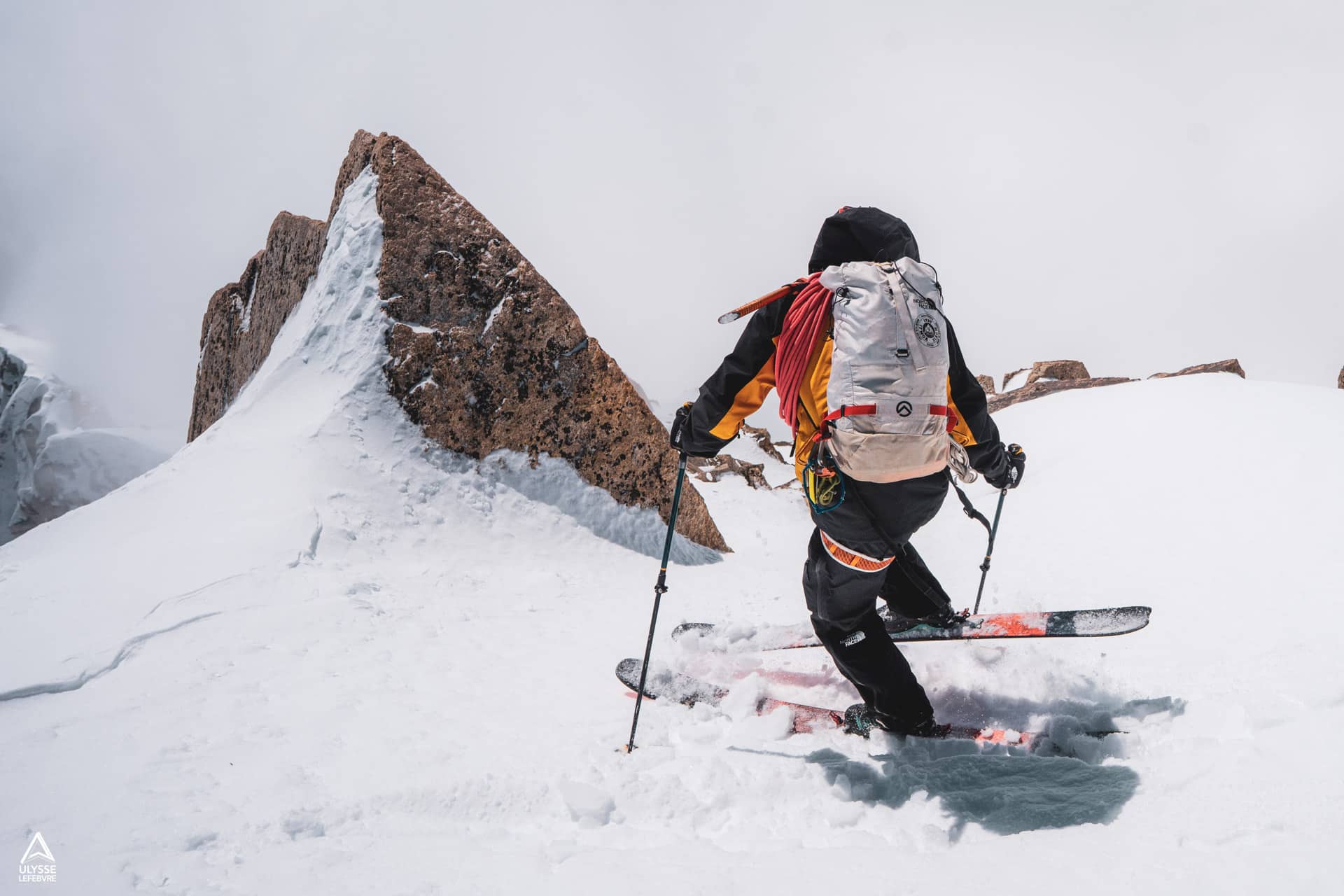
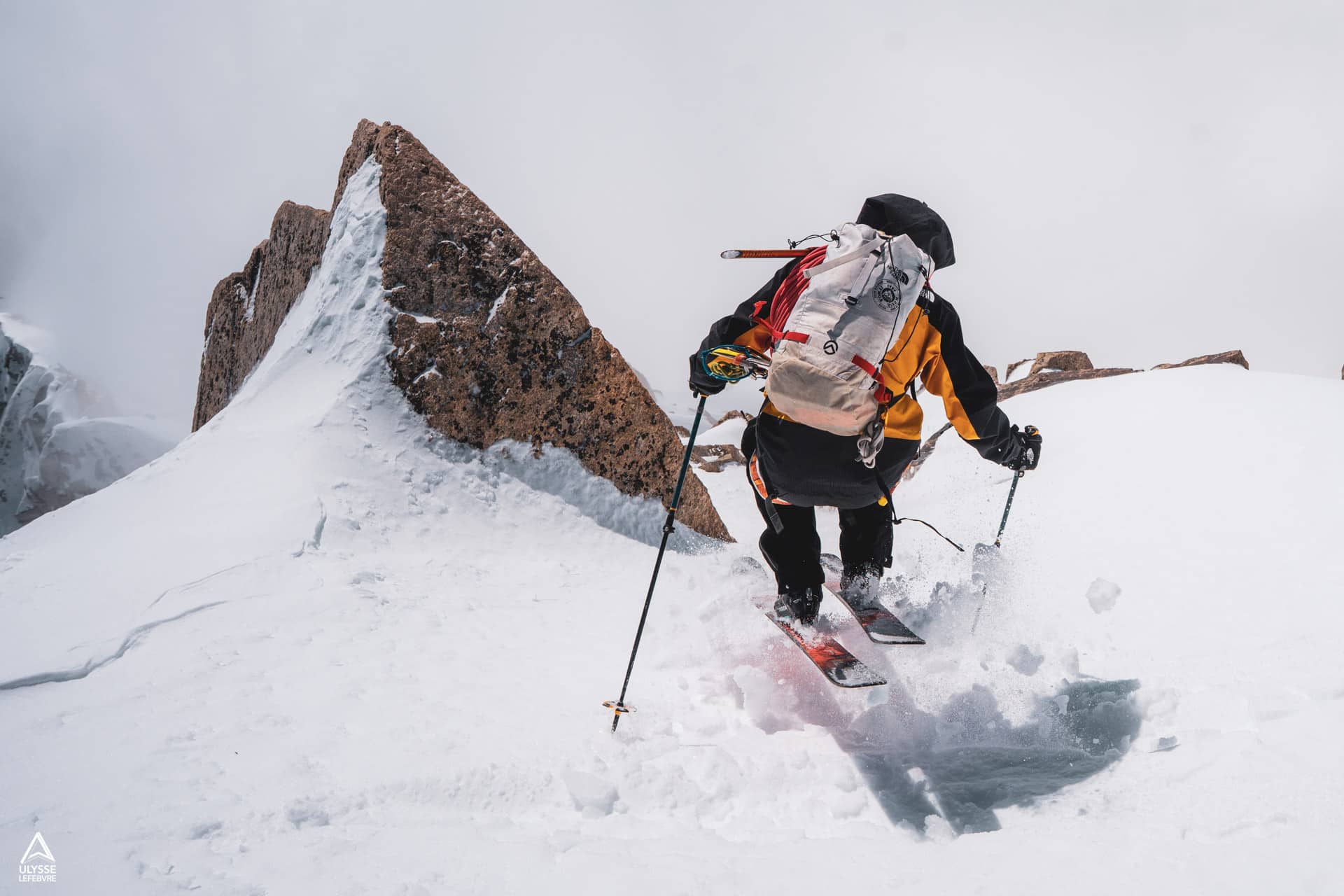
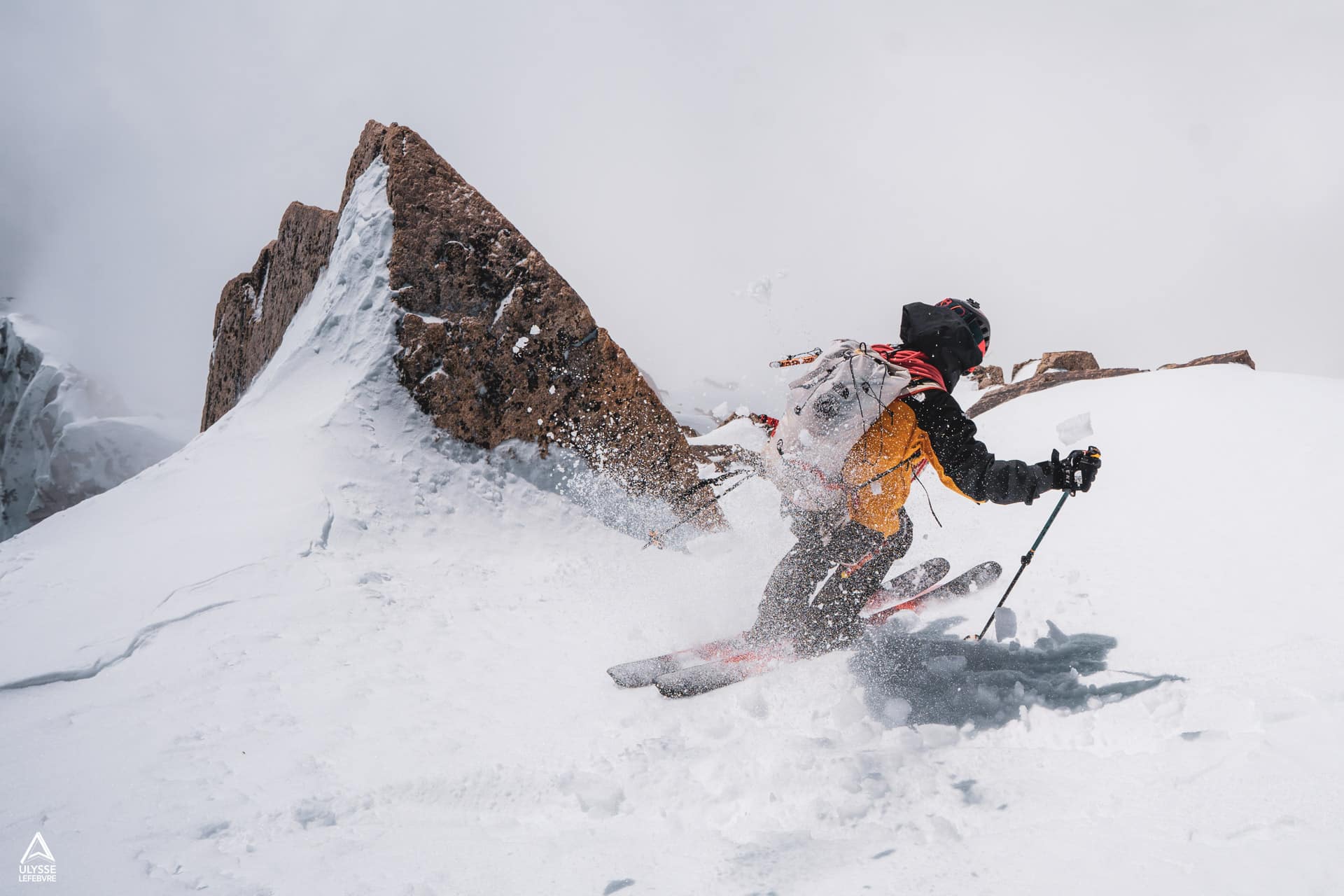
Expeditions and ethics
On the highest peaks, Tom takes a demanding approach. « I don’t differentiate between following a route with fixed ropes or clipping onto them. In both cases, it’s not alpine style.». For example, he claims an ‘unsupported’ ascent of Broad Peak in 2023, a relatively easy peak that does not necessarily require the use of fixed ropes for the most experienced mountaineers.
It’s less obvious on Nanga Parbat, which he will attempt in 2024, particularly the Kinshofer Wall, a 150-metre vertical wall that could be rated 6a/6b if it had to be climbed free, without ropes in place, at an altitude of 6,000 metres. « On the Kinshofer, I tried not to clip in. Matheo [Jacquemoud] said to me, It’s a 3,000-metre face, you could get hit on the head. It’s true… but that’s how I am ».
follow a track with fixed ropes
or clip onto them in both cases
it’s not alpine style
He shares a radical approach with Anna Tybor, a Polish climber he met in Chamonix. « She has a warrior mentality that only Poles have » he says. At Dhaulagiri in 2024, they were forced to give up due to a huge disturbance.
At Nanga Parbat that same year, their paths crossed again. A hundred metres below the 8,126 m summit, they had to give up. On the day of the failed summit push, they set off too late – at 8 p.m. instead of 6 p.m. Then everything happened very quickly.
Tom recalls: « ‘m in my own little world, in my hood. When I start thinking again, the summit no longer seems like an option ». The cold bites, accentuated by his ski boots: » The heaters prevent your feet from freezing, but they don’t stop you from losing feeling in them ».
A storm above the clouds, around 10:30 a.m., brings him back to reality. Anna, meanwhile, no longer speaks, silently giving up like a warrior. ‘When I said I was giving up 100 metres below the summit, she hardly responded. She just moved away… and put on her boots.’
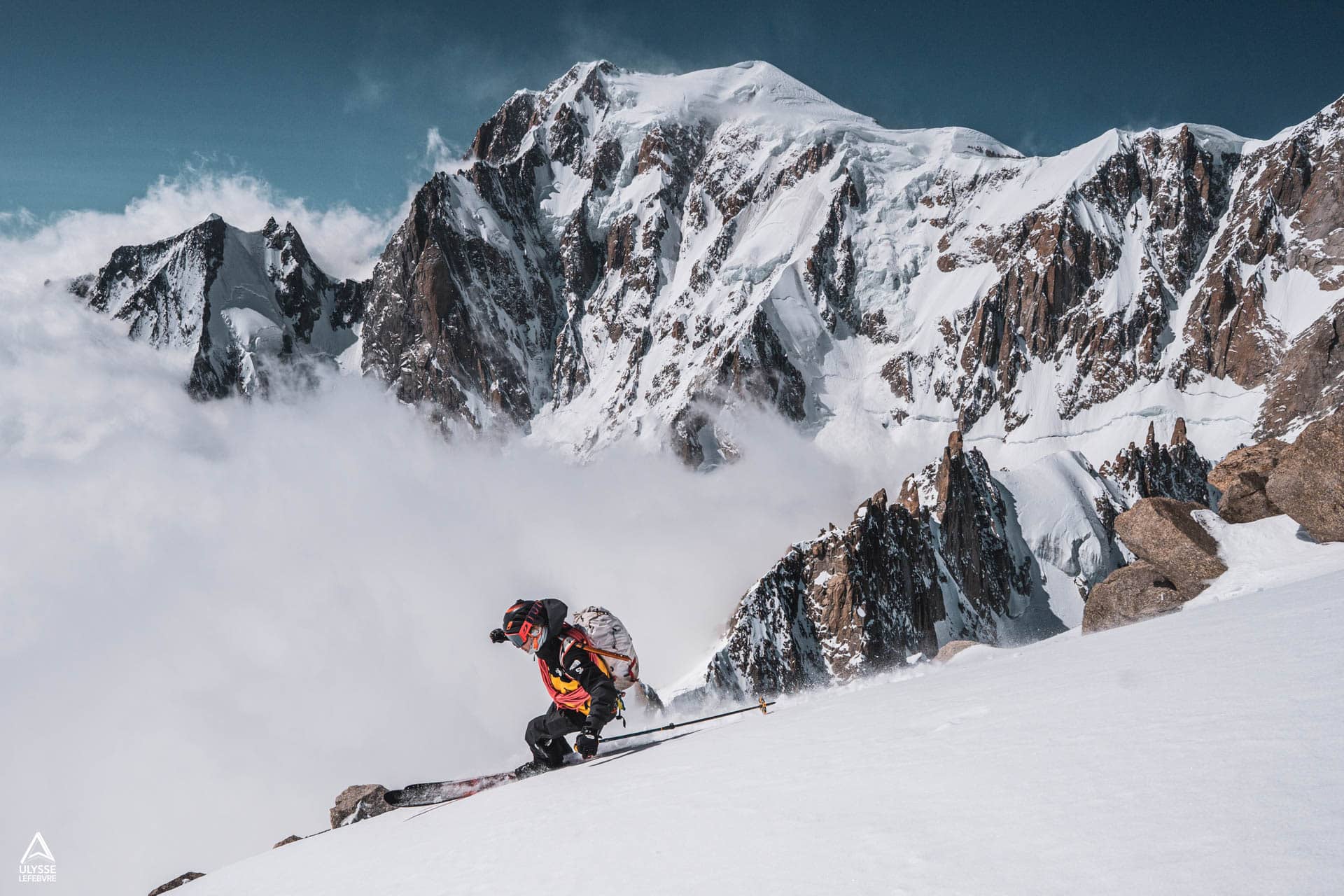
The name Jean-Christophe Lafaille is everywhere in Mont Blanc. Tom drawq his lines there. ©UL / Gore-Tex
Skiing as a language
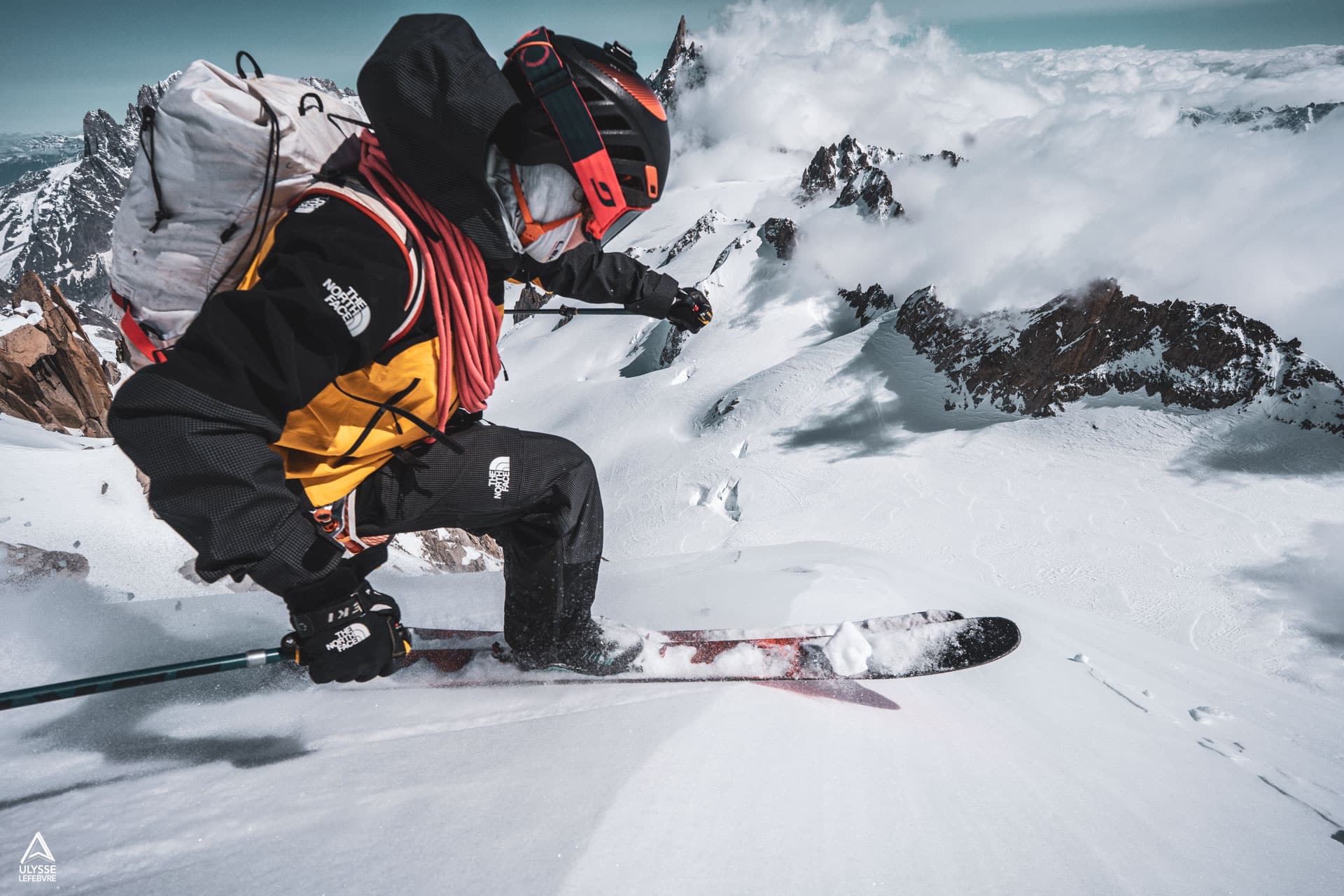
Contrary to what some people imagine, Tom never saw skiing as a way to escape his father’s influence, but « rather as a way to combine all the facets of the mountains. » In the Himalayas, he skis during each acclimatisation rotation « to descend faster and more safely.»
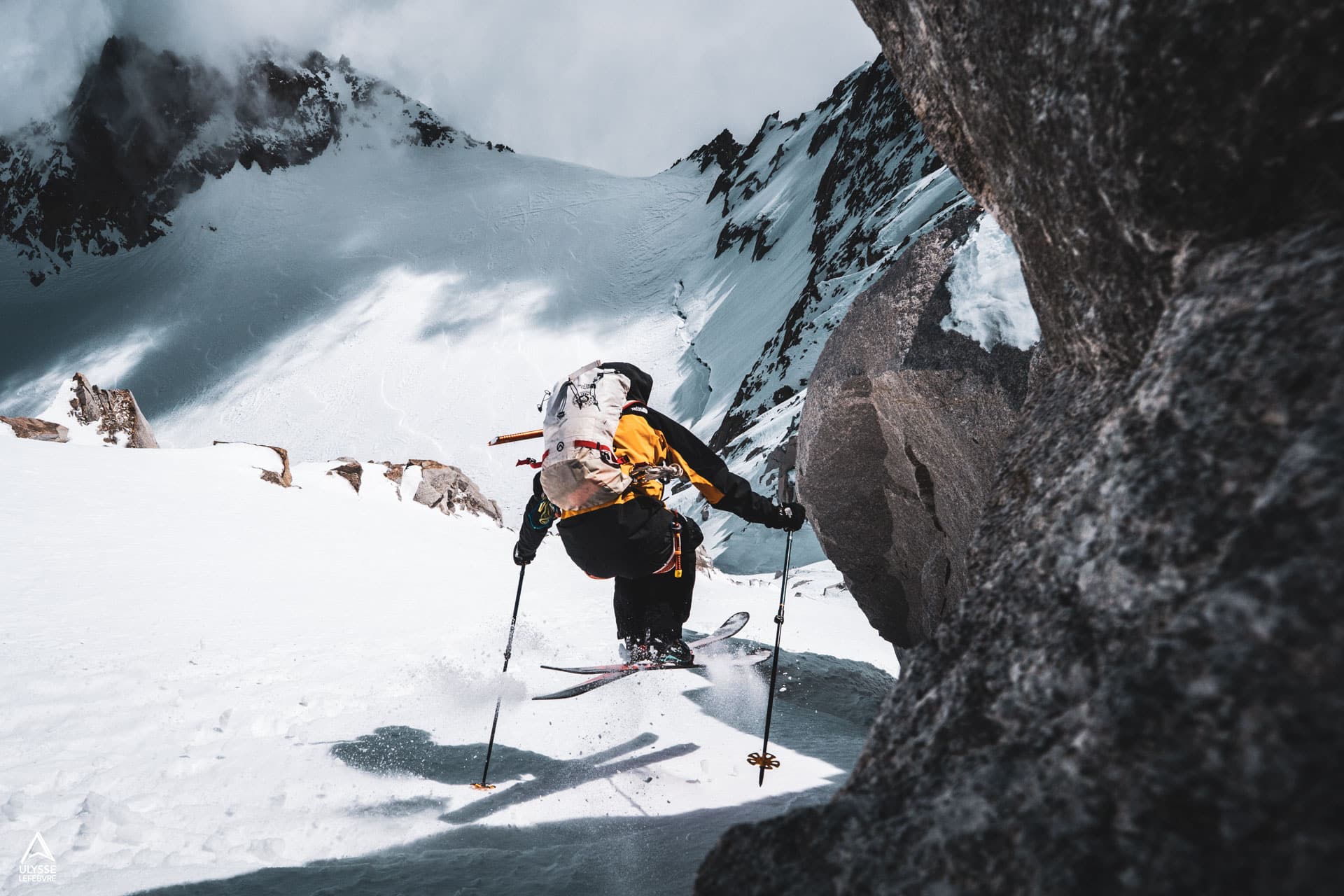
At home, one of his favourite playgrounds remains the Aiguilles Rouges massif, where he has racked up lines with Bruchez. « It’s a bit like home to me… but we don’t talk about it too much. It’s more freeriding, the kind of thing where you have to go for risk level 4 to make it good,» he says with a smile. Not very politically correct, you might say.
skiing, as a way of combining
all aspects of the mountains
A young mountain guide turning professional
At 20 years old, some clients raise their eyebrows when they see this baby-faced guide. « But when they’re behind me with their crampons on, they’re still glad I’m there! » Tom loves this diversity: « It’s great to meet lots of different people, but they’re all on the same level once they’re up there. »
He doesn’t actually work much as a guide and mainly lives off his sponsors. « They don’t put pressure on me to use social media. I think it’s a great way to share, but it can be toxic. I’m not crazy about posting. I didn’t even post about Dhaulagiri!» At the time of publishing this article, his last Instagram post was in early October 2025, a month and a half ago, which is an extremely long time in an era where sponsored athletes are omnipresent on social media.
©UL / Gore-Tex
Finding companions, finding limits
Tom acknowledges the difficulty of finding partners with the same requirements: ethics, technical level, risk management, time, training. As for his own limits: « It’s not easy to define. In climbing, ratings help. In the mountains… it’s different. But I have limits, don’t worry. »
Tom speaks slowly, weighing his words, with a manner reminiscent of Vivian Bruchez, his mentor, a mixture of reflection and quiet confidence. He is a young man who grew up among mountains and base camps, at ease with clients from all over the world. He speaks impeccable English, « which he didn’t learn so much at school as while travelling ».
©UL / Gore-Tex
I don’t know
what I would have done
in his place
He finally knows that his father’s shadow will never truly disappear, that his memory remains vivid and alive: « Once, during a climbing competition at the Lafaille gymnasium in Grenoble, a guy came up to me and told me how much he admired my father… before asking me if he was in the room. »
Tom does not seek to erase him; he has learned to accept him. Even if he does not fully forgive his father for choosing to marry the mountains, he says he understands him today: « I don’t forgive him for everything, but I understand him… and I don’t know what I would have done in his place. »
So Tom Lafaille moves forward, simply, with his own path, his own commitment, and a vision of the mountains that belongs only to him. Even if Makalu, in his sights, could well be a final tribute, in his own way, to his father’s name.
TOM USES
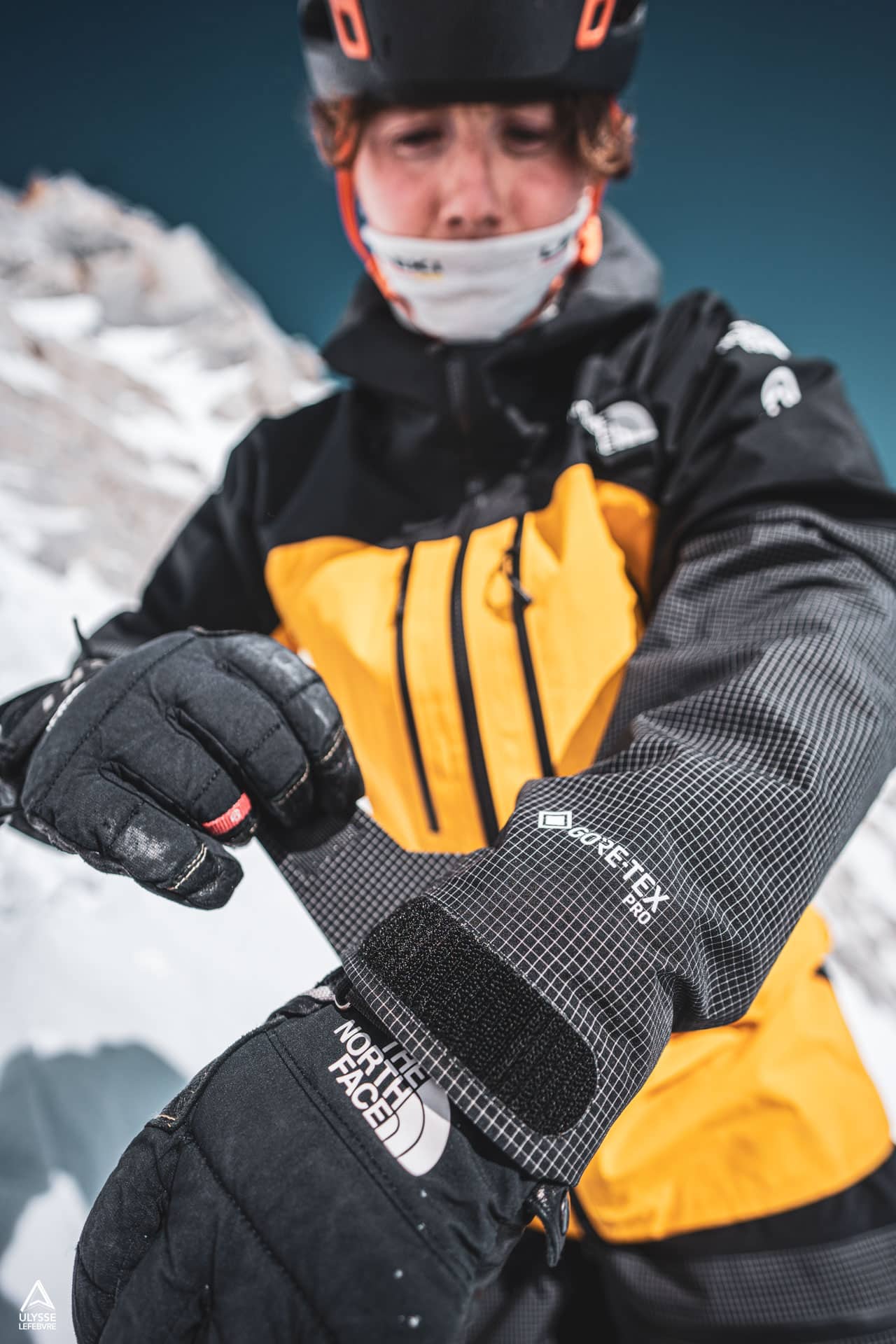
GORE-TEX PRO
NEW GENERATION PRODUCTS
Launched this winter 2025, the new generation of GORE-TEX Pro products feature an innovative ePE membrane and are designed for athletes and professionals who tackle extreme environments.
Whether ice climbing or rock climbing, GORE-TEX Pro products have been specially designed for the most challenging conditions in the mountains.
Waterproof, windproof and breathable, each garment offers the well-known benefits of the GORE-TEX brand. They are extremely durable, PFAS-free and have a reduced carbon footprint.